
Relief from leaks
is possible
Approximately 78 million women in the U.S. suffer from urinary incontinence (UI) and of those more than 37% have Stress Urinary Incontinence (SUI).

Find your path to incontinence relief
No two people walk the same path to a diagnosis or a solution. Every woman’s experience with stress urinary incontinence (SUI) is different, and they may reach these steps at different paces and during different stages in their lives.



The right doctor will listen to you and put your needs first. But how do you find them?


Are you living with Stress Urinary Incontinence?
The muscles in your urethra work like a valve, opening and closing as needed to let urine out. But with stress urinary incontinence, also called SUI, the pelvic muscles that normally support the bladder and the urethra are weakened.
When this happens, urine leaks out of the bladder and can leave you feeling embarrassed, frustrated and unsure of what is happening to you.
Symptoms of stress urinary incontinence
Do you leak during any of the following activities?:
- Laughing
- Coughing
- Sneezing
- Heavy lifting
- Physical activity
- Sex
If you can say “yes” to one or more, you should talk to a doctor who is familiar with SUI and discuss a more permanent solution for treating urine leakage.


What causes SUI?
SUI can slowly develop as you age and may also be the result of a specific event such as childbirth, or be a result of smoking, obesity or other previous tissue traumas in the area.2
What are your treatment options?
You name it, you’ve tried it. From pads, diapers, special underwear and Kegels – some of it helps, but doesn’t relieve the burden of SUI. You deserve a treatment that addresses the source of the problem, not something that just provides a temporary fix for symptoms.

Avoiding and covering up leaks only adds to the burden of having SUI in the first place. A lasting solution, with minimal downtime, can help relieve the added burden of constantly hiding your SUI symptoms.
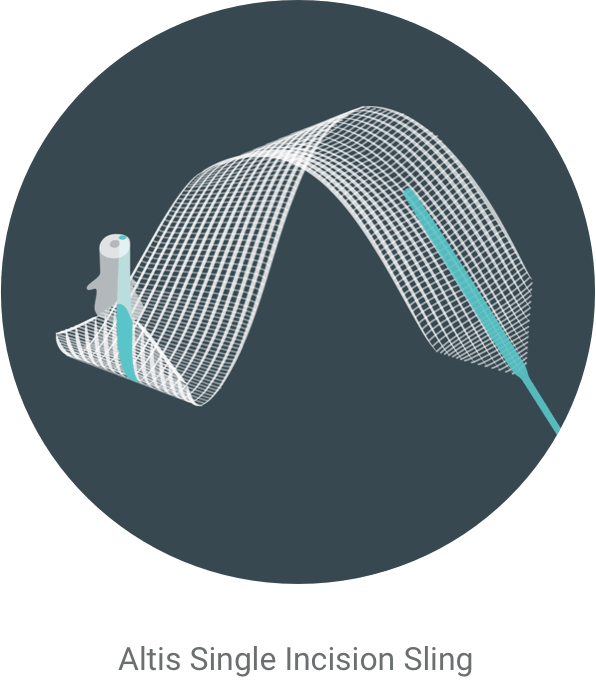
Luckily, there’s Altis® Single Incision Sling.
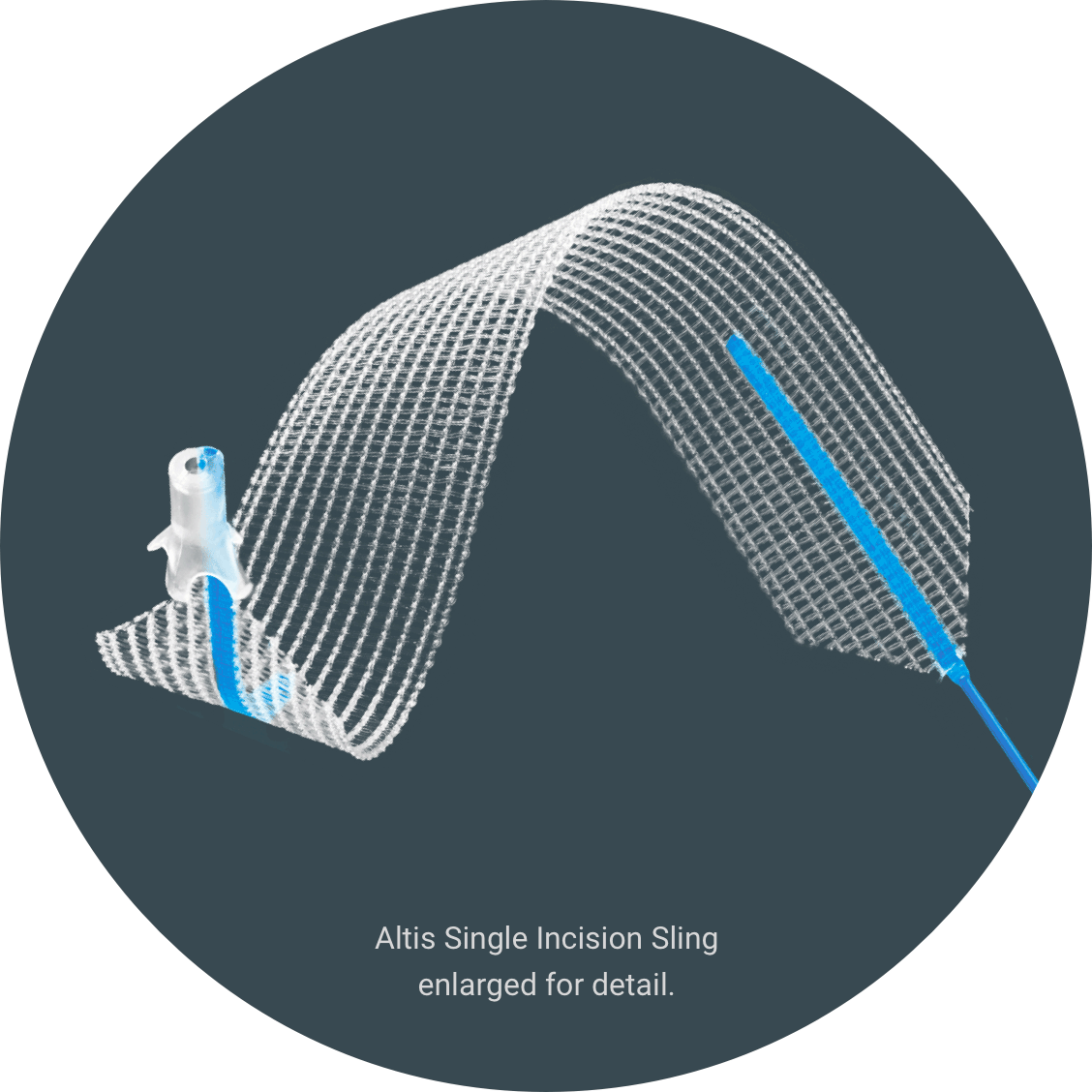
Introducing Altis®
Women experiencing SUI deserve a clinically proven, effective solution. Altis is a treatment backed by clinical studies with firsthand testimonials from women who’ve had the procedure with successful outcomes.
Altis is a lasting solution, with minimal downtime, that can help relieve the added burden of constantly hiding your SUI symptoms and allow you to return to your activities faster.3 This procedure can be performed in an outpatient setting3, under local anesthesia4 and the surgery takes around 30 minutes or less.5

What have others experienced?
92.9%
of women reported feeling
“very much better” or “much better”
at 3 years6
89.1%
of Altis patients were “very satisfied” or “satisfied” and would recommend the surgery to someone else6
0
Find a specialist
Locate a pelvic surgery specialist near you

Take back your normal
Locating a doctor with the expertise and empathy to treat your condition is key. You’re probably wondering, “Is there a pelvic surgical specialist near me?” We’ve got that covered.
Simply enter your ZIP code to see a listing of pelvic doctors in your area. Each listing provides the doctor’s name and area of pelvic health expertise, along with their website, phone number and distance from your home.
By dialing one of the phone numbers below, you consent to Coloplast connecting you with a physician and to the collection of your personal information for Coloplast’s quality improvement activities in accordance with the Coloplast Privacy Policy.
This directory was created and is maintained by Coloplast. It is intended to support patients who want to learn more about treatment options for stress urinary incontinence (SUI) and pelvic organ prolapse (POP) by helping connect them to physicians who have demonstrated qualifications and interest in providing quality care for these conditions. Names and details in this directory are provided for your information only. Decisions regarding choice of physician and treatment are a patient’s responsibility, as is all communication and interaction with listed medical professionals. Any information you send to a physician is not covered by the Coloplast Privacy Policy.
Physicians listed on the Physician Locator pay no fee for inclusion. Some physicians on this list may purchase products from, provide consulting services to and/or be a party to a co-marketing agreement with Coloplast. Coloplast makes no representations or warranties regarding, and shall not be responsible for, the competencies or skill level of any of the physicians listed on the Physician Locator or the quality of their procedural outcomes. You and your physician must determine the right procedure for you.
Important safety information
Important Safety Information
Stress urinary incontinence is a condition in which urine involuntarily leaks at times of increased pressure on the bladder (e.g., coughing, sneezing, laughing, lifting heavy objects, exercise). Stress urinary incontinence can be treated with a surgical procedure in which a mesh sling is implanted to act as a “hammock” to support the urethra, the tube that connects to the bladder that carries urine outside the body. An incontinence sling surgery involves anesthesia and may require an overnight hospital stay.
The Altis Single Incision Sling System is indicated for the treatment of female stress urinary incontinence (SUI) resulting from the urethra not closing properly (urethral hypermobility) and/or weakness of the urethral sphincter (intrinsic sphincter deficiency (ISD)).
Your physician should advise that the Altis Single Incision Sling System is not for females who have the following: are pregnant or have desire for future pregnancy • potential for further growth (e.g., adolescents) • known active urinary tract infection and/or infection in operative field • taking blood thinning medication (anti-coagulant therapy) • abnormal urethra (e.g., fistula, diverticulum) • any condition, including known or suspected pelvic pathology, which could compromise implant or implant placement, and • sensitivity/allergy to polypropylene or polyurethane.
Discuss with your physician:
- The reason for choosing a mesh sling including the warnings, precautions and risks associated with its use
- Alternative incontinence treatments that may be appropriate
- The Altis sling to be implanted is permanent
- Serious mesh associated complications may result in one or more revision surgeries
- Partial or complete removal of the mesh may not always be possible or advisable as it may not fully correct these complications
- New onset (de novo) complications and recurring or worsening SUI can occur
- There may be unresolved pain with or without mesh explant and varying degrees of scarring may occur
- Certain underlying conditions may be more susceptible to postoperative bleeding, impaired blood supply, compromised/delayed healing, mesh sling exposure or other complications
Potential additional risks versus benefits of using Altis should be considered in patients with one or more of the following: age-related underlying conditions • autoimmune disease • coagulation disorder • connective tissue disorder • debilitated or immunocompromised state • diabetes • pelvic radiation therapy or chemotherapy • physical characteristics (e.g., body mass index) • renal insufficiency • smoking-related underlying conditions, or • urinary tract anomalies.
Any future pregnancy could negate the benefits of this surgical procedure. Patients should report bleeding, pain, abnormal vaginal discharge or signs of infection at any time.
Complications are known to occur and may be immediate or delayed, localized or systemic, new onset (de novo) or worsening, acute or chronic, transient or permanent, new onset (de novo) or continuing, worsening, transient, or permanent.
Potential complications may include but are not limited to:
|
|
This treatment is prescribed by your physician. Discuss the treatment options with your physician to understand the risks and benefits of the various options to determine if a mesh sling is right for you.
Caution: Federal law (USA) restricts this device to sale by or on the order of a physician.
Minneapolis, MN
PM-03328 02/2024
References:
-
- Patel UJ, Godecker AL, Giles DL, Brown HW. Updated Prevalence of Urinary Incontinence in Women: 2015-2018 National Population-Based Survey Data. Female Pelvic Med Reconstr Surg. 2022 Jan 12.
- Trowbridge ER, Hoover EF. Evaluation and treatment of urinary incontinence in women. Gastroenterol Clin North Am. 2022;51(1):157-175. doi:10.1016/j.gtc.2021.10.010.
- Erickson T, Roovers JP, Gheiler E, et al. A Multicenter Prospective Study Evaluating Efficacy and Safety of a Single-incision Sling Procedure for Stress Urinary Incontinence. J Minim Invasive Gynecol. 2021;28(1):93-99. doi:10.1016/j.jmig.2020.04.014.
- Altis Instructions for Use.
- Urology Care Foundation. Stress Urinary Incontinence (SUI): Symptoms, Diagnosis & Treatment. Updated August 2023. Accessed March 24, 2026.
- Erickson T, Gheiler E, Hanson C, McCrery R, Parekh M, Parva M, Tu LM. Patient Satisfaction and QoL in SUI: Results With Single-Incision or Full-Length Slings. Urogynecology. Published online October 18, 2024.
PM-26150