
Jordan | Treated for SUI with the Altis Single Incision Sling
You may have experienced urine leakage for years. But did you know that there’s a lasting, effective solution for the source of your symptoms?
There’s a way to get you back out there – running, jumping, laughing, coughing, sneezing – and worrying less about leaks.
How Altis works
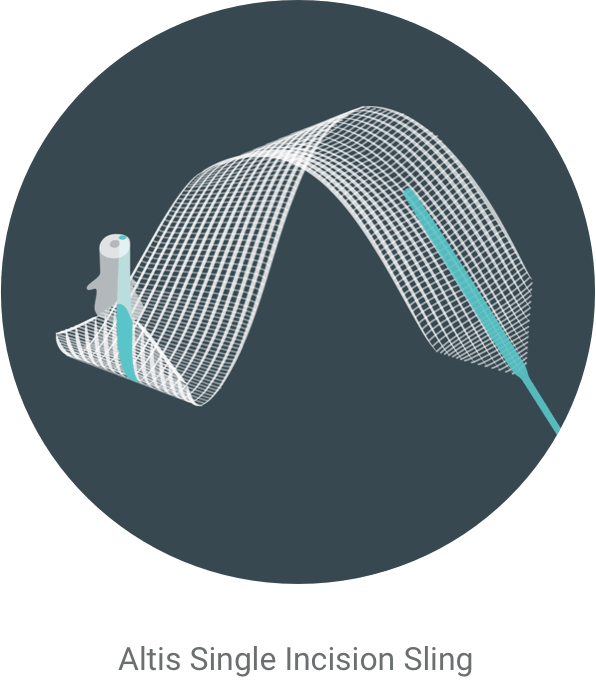
During the procedure, your doctor will make one small incision (typically 0.6-0.8 of an inch) to place an Altis sling as a steady, even “backboard” of support for the urethra1 when there is stress on your bladder, such as when you cough, laugh or sneeze.2
Altis is a lasting solution, with minimal downtime, that can help relieve the added burden of constantly hiding your SUI symptoms and allow you to return to your activities faster.3
This procedure can be performed in an outpatient setting, under local anesthesia4 and the surgery takes around 30 minutes or less.1
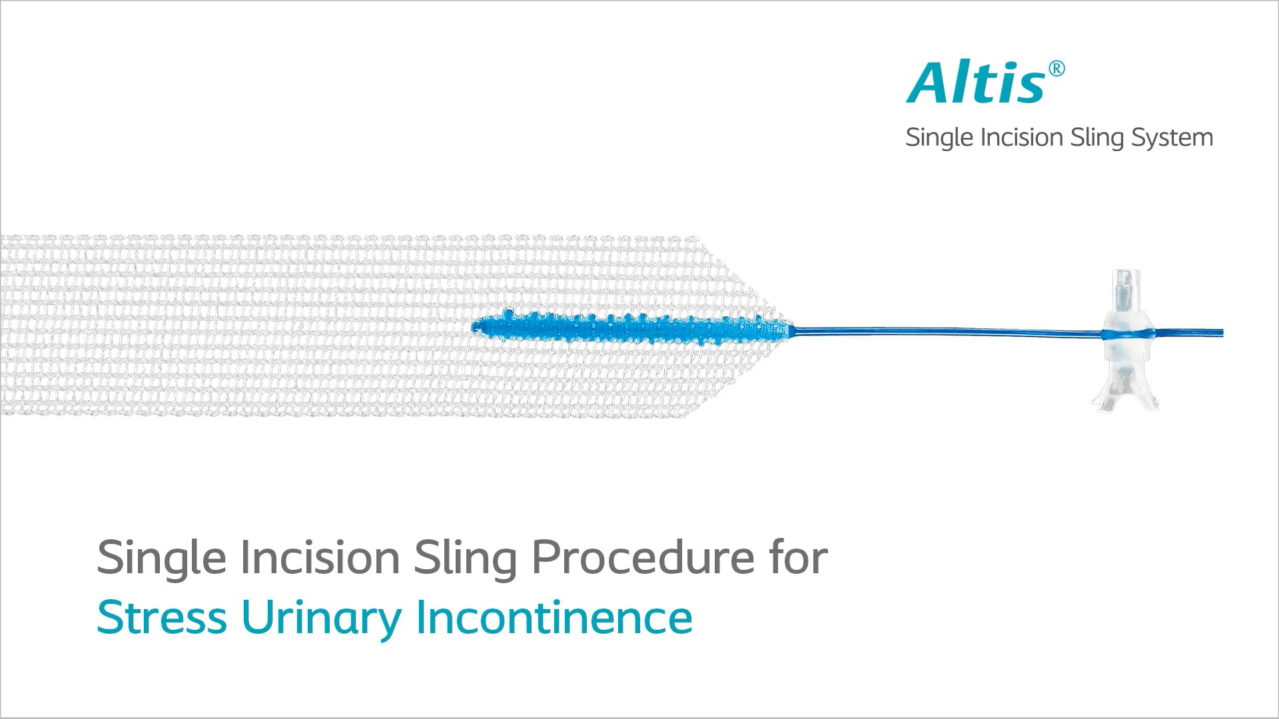
Women receiving single incision slings reported lower post-op pain, earlier return to normal activities, and earlier return to work compared to those receiving traditional slings.5
|
Reduced procedure
|
Less post-op pain
|
Lower rates of
|
Quicker return to
|





Dana | Treated for SUI with the Altis Single Incision Sling
Women experiencing SUI deserve a clinically proven, effective solution.
The Altis Single Incision Sling is a long-lasting treatment for SUI backed by clinical studies that prove a significant improvement to quality of life after 3 years.6
Women who’ve had the procedure have reported successful outcomes
92.9%
of women reported feeling
“very much better” or
“much better” at 3 years6
89.1%
of Altis patients were “very satisfied” or
“satisfied” and would recommend the surgery to someone else6
What to expect before, during and after surgery
Before surgery – Medical history
First, your doctor will collect and review your medical history and recent experiences. You will be asked to provide a list of all medications and supplements you take, and information about your urinary habits and normal fluid consumption. It’s important to accurately describe the leakage you are having, such as when and under what conditions leakage occurs.
Before surgery – Physical exam
Then, you’ll likely have a physical exam, which can include:
- Cough stress test – you will cough and bear down with a full bladder to see if urine leaks
- Urinalysis – testing of a urine sample
- Pad test – from an absorbent pad that is worn, estimate how much you are leaking throughout the day to determine severity of your urinary incontinence from an absorbent pad that is worn, estimate how much you are leaking throughout the day to determine severity of your urinary incontinence
- Post-void residual – measures the amount of urine left in your bladder after urinating
- Cystoscopy – use of a scope (camera) to examine your bladder
- Urodynamics – testing that measures amount of urine in the bladder before urinating and the force of the urine as it leaves
Based on the results of your physical exam, you and your doctor will discuss and decide the right solution for your specific needs.
During surgery
Midurethal slings are the most commonly performed SUI operation. The Altis Single Incision Sling can be performed as an outpatient procedure under local anesthesia, in around 30 minutes or less.
Slings are placed through a small incision in the vagina and placed under the urethra. Once placed, the sling provides consistent support and stability to the urethra, reducing the stress to your bladder and possible urine leaks.
After surgery and into recovery
Your doctor will provide information about your recovery plan. In general, following sling placement, your doctor may suggest you resume some activities after two weeks, while avoiding others like physical strain, sexual intercourse and heavy lifting for up to six weeks.
Contact your physician if you experience bleeding, pain, or any signs of infection.


FAQs
Urinary incontinence 101
What is urinary incontinence?
Urinary incontinence happens when a person loses voluntary control over their urinary functions.
About 78 million
women in the U.S. suffer from urinary incontinence.
Are there different types of urine leakage?
The most common types are stress urinary incontinence, urge urinary incontinence and mixed urinary incontinence.
- Stress Urinary incontinence (SUI): Involuntary loss of urine when stress or pressure is placed on the bladder with activities such as running, sneezing, coughing, laughing, exercise or other physical activity, sex, or heavy lifting. Urine can leak without the urge to go to the bathroom. SUI does not have a connection to emotional stress.
- Urge urinary incontinence (UUI): Involuntary leakage that occurs when there is a strong, urgent need to urinate even when the bladder isn’t full. OAB or Overactive Bladder is the urge to urinate whether or not you leak.
- Mixed urinary incontinence (MUI): Combination of both stress and urge incontinence.
What causes stress urinary incontinence?
SUI generally occurs when your pelvic muscles are not strong enough to keep the opening of the bladder neck closed when there’s pressure on your bladder. It can slowly develop as you age and may be the result of a specific event such as childbirth, or be a result of chronic smoking, constipation, obesity, aging, heavy lifting, or genetics.
SUI treatment options
What are my treatment options?
Treatment options for stress urinary incontinence range from the day-to-day management of symptoms to surgical treatments that provide a more long-term solution. Examples of non-surgical options include wearing pads or absorbent underwear, lifestyle changes, vaginal pessaries, or improving pelvic strength through muscle exercises.
Surgical treatments for SUI include a sling procedure and injectable bulking agents.
Can stress urinary incontinence be successfully treated?
Yes, SUI can be treated successfully.
Talk to your doctor to discuss what treatment might be right for you.
What kind of doctor should I talk to?
On average, women wait 6.5 years from the first time they experience symptoms until they obtain a diagnosis for their bladder control problem(s). That’s why finding the right physician to treat your SUI is a very important step in seeking treatment. It’s important that your doctor listens to you, advocates for your best interest, and provides the right path for your specific needs. Specialists that typically treat SUI are urogynecologists, urologists, and gynecologists.
What is stress urinary incontinence surgery?
You may have heard about surgical procedures for addressing SUI.
- Injectable bulking agents – Synthetic materials are injected into the tissue around the urethra to provide support and to tighten the opening of the bladder neck. It may take two to three or more injections to get the desired result. The injections may improve symptoms but usually do not result in a complete cure of incontinence.
- Midurethral slings treat urinary incontinence by supporting the urethra to keep it in its correct position and preventing leaks during physical activity. Midurethral slings are the most commonly performed SUI operation. These procedures have been done for over 20 years with excellent results.
Are there different types of slings?
There are three types of slings available: retropubic, transobturator, and single incision slings.
For full-length slings (retropubic and transobturator slings), a small incision is made in the vagina and two small skin incisions are made near the pubic bone or in the groin area. The surgeon then places the sling under the urethra and pulls the ends of the sling through the skin incisions and adjusts them to be in the right position in the body.
For single incision slings, a single small incision typically 1-2cm is made beneath the urethra. The sling is then placed beneath the urethra to provide support to it when there is stress placed on the bladder.
A sling is chosen for treatment based on several factors, including the severity of incontinence and prior pelvic surgery, as well as patient and doctor preferences.
SUI surgical treatment outcomes and recovery
Will I be able to feel the sling?
It’s possible. Every person’s physician anatomy is different, so everyone experiences the sling differently.
Are there any risks?
Like any surgery, there are some risks related to the procedure. Talk to your doctor to discuss these risks in detail.
See important safety information and the following links for more information.
What is the recovery time?
Maybe you have been putting off a surgical option for treating your leaks because you can’t afford to be out of commission. Work needs you. Your family needs you.
Your doctor will provide you with information about your recovery. Generally, following your sling placement, expect to avoid physical strain, sexual intercourse, and heavy lifting for 6 weeks, but you’ll likely be able to resume other normal activities after 2 weeks.
SUI surgical treatment cost and coverage
What does this cost? Will my insurance cover stress incontinence surgery?
Most insurance plans, including Medicare, cover these procedures.
Consult your insurance carrier to find out the specific criteria for coverage. The reimbursement specialist at your physician’s office may also be able to help you with this.
Not sure where to start?
Take our short, free, and confidential self-assessment.
Help is on the way.